



ELENA SCHUMACHER
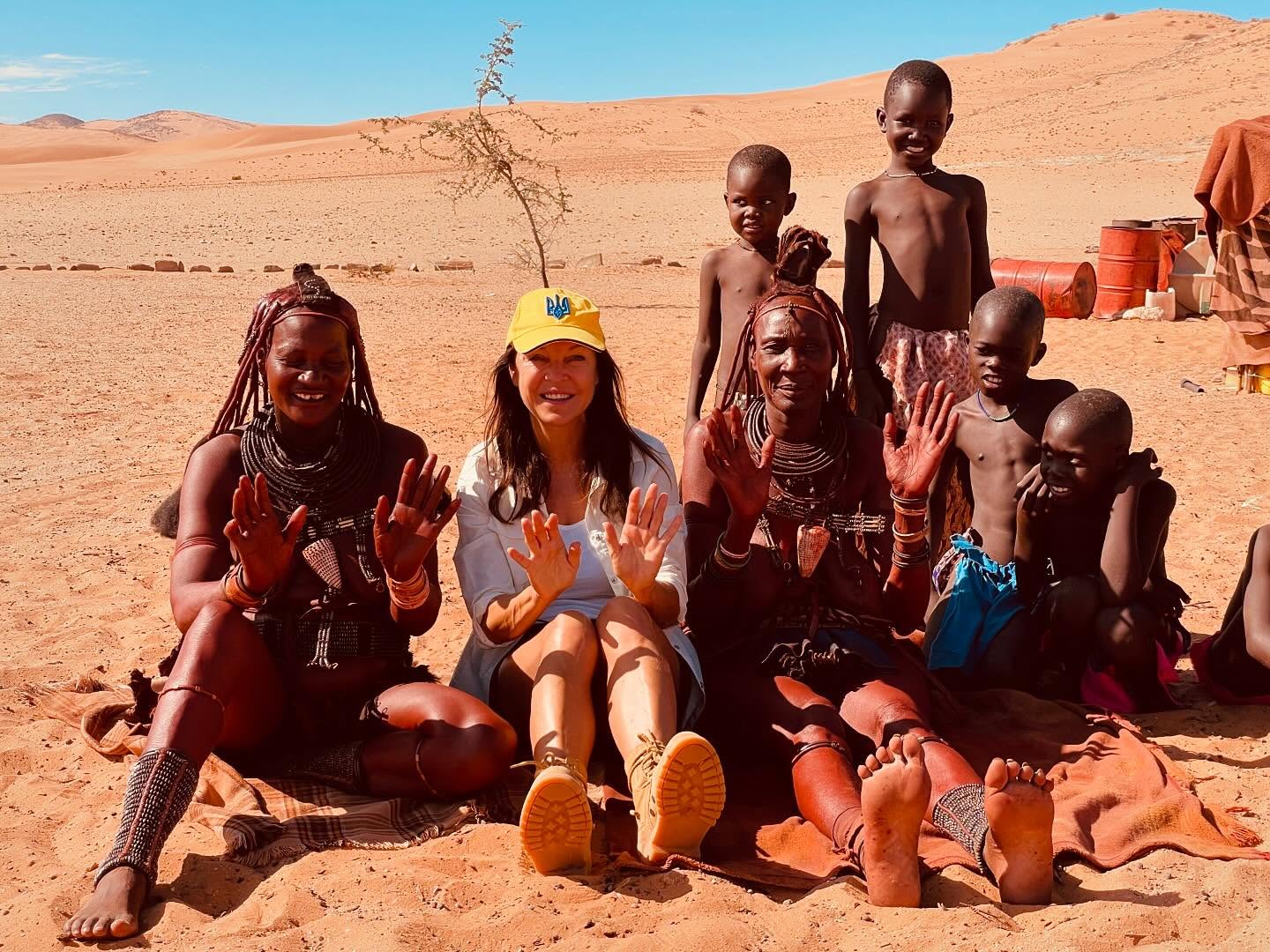
I first travelled to Namibia in 2010 and was captivated by its diverse cultures and extraordinary landscapes. Some of the most vulnerable ethnic groups, such as the San and the Himba, struggle every day to survive while preserving their cultures in this desert country.
I returned to this fascinating country every year, often several times, and made documentaries about its different cultures. The more I learned about its communities and traditions, the more I saw that many children were not attending school, despite compulsory education. Poverty, hunger, a lack of awareness and inadequate infrastructure across this vast country stood in their way. And yet Namibia urgently needs a well-educated population to move forward.
That was how my determination to help children gain access to education was born. But establishing safe, transparent ways to provide support is far from easy. It requires relationships of trust that can only be built through time and dedication.
When I met Koviao Mbaha, a young Herero girl living with her mother in a hut without water or electricity in a very poor settlement, I knew I had found a way forward. Her talent and determination inspired me to establish my organisation. With our support, she graduated from the University of Namibia at the end of 2024. Today, she works for a local mining company, putting her knowledge of environmental biology to work for her country.
At the same time, my friendship with Domenica Deiure (Mimma), a European woman living in Namibia who shared my ideas and enthusiasm for supporting children’s education, led us to combine our strengths, knowledge and resources to create a new project. This gave rise to the Enghandja Community School project, an initiative created by local people for their own community that can only become a reality with outside support. In these rural communities in the far north of Namibia, schools for young children are far away, and families cannot reach them because of the distance and cost. In Enghandja, we have been providing schooling for children from the age of five for three years, and some are now in their second year of primary school.
For the past two years, we have also supported the school, nursery and orphanage in Sorre Sorres, in central Namibia. This wonderful initiative by Morina Angula, with whom we work to provide education, food and care for 18 children, is an example of dedication, hard work and cooperation between our organisation and local leaders. We communicate with them daily to decide together how donations should be used according to current needs.
Education is the best way out of poverty; this is our organisation’s guiding principle.
DOMENICA DEIURE (Mimma)
I first travelled to Namibia with my son 13 years ago. I had already visited other countries in Asia and Africa, but I decided to stay in Namibia and devote my life to its people, especially vulnerable children. My life changed completely.
At first, I volunteered at the Mammadu Centre in Otjomuise, near the capital, Windhoek, where I devoted all my time and energy to caring for 60 children. During that time, I began thinking about establishing a new organisation to promote education in Namibia. The opportunity arose when I met Elena in Etosha National Park, where I had taken children from the township on an outing. We immediately felt a connection through our shared desire to care for and educate Namibian children. From that moment on, we pursued that vision together and turned our shared passion into a concrete project.
A good friend, Lukas Hamalawa, from northern Namibia, took me to the rural community of Enghandja to show me how urgently its children needed a school. Without one, many of them would never have the opportunity to receive an education. That was the moment the Enghandja Community School was born.
Over the following months, we arranged meetings with Reverend Hainane, the community leader and the people of Enghandja, and found a suitable plot of land where we could build the school, a house, toilets and other facilities. To begin teaching, the community lent us its church, a wall-less hut where people gather on Sundays.
Our main goal is to construct a proper school building, because for the past three years we have been using this church hut as a classroom. It has no electricity or running water, and its dusty dirt floor makes teaching difficult.
Our donors can be assured that every cent donated goes towards the children’s education and food.
